On September 11, 2026, the Florida Department of Health entered final orders granting 22 new Medical Marijuana Treatment Center licenses, ending an application cycle that opened in April 2023. The Marijuana Herald +3
For the operators who hold those licenses, the long wait is over. Now it's time to build.
Flourish has been part of Florida's medical cannabis market since 2017. We've supported one of the state's largest vertically integrated operators as it scaled its footprint, helped newer MMTCs stand up cultivation and manufacturing from their first harvest, and were part of the state's BioTrack seed-to-sale system launch in 2024. We understand what the path from license to first patient actually looks like, where operators lose time, and what to require of the software that must support cultivation, processing, transport, and dispensing in a single platform.
From SB 8-A to the September 11 final order
Florida's licensing formula dates to SB 8-A, the 2017 law that implemented Amendment 2. It requires the Department of Health to license four additional MMTCs within six months after the Medical Marijuana Use Registry reaches 100,000 active qualified patients, and four more for each additional 100,000 active qualified patients. (Cited: Florida Senate).
The state reported 941,271 active qualified patients in its September 11, 2026, update, well past the thresholds this cycle was meant to address.
The current licenses come from an application window that opened in April 2023. The state issued notices of intent to award 22 licenses on November 26, 2024.
Denied applicants challenged the scoring before the Division of Administrative Hearings, resulting in a three-month evidentiary hearing from October 2025 through January 2026. In May 2026, Administrative Law Judge Mary Li Creasy recommended rescoring the applications. The Department declined to adopt that recommendation and awarded the licenses to the 22 applicants it originally selected in November 2024. The new licenses are numbered MMTC-2026-0029 through MMTC-2026-0050.
Each licensee had to post a $5 million surety bond, irrevocable letter of credit, or cash within 10 business days of licensure.
Unsuccessful applicants have 30 days from the Final Order to seek review at Florida's First District Court of Appeal. Vicente LLP partner Sally Kent Peebles, quoted in MJBizDaily in September 2026, expects both appeals and a request to pause licensing. Build your plan on the license you hold, but have your counsel keep your investors and lenders informed about appellate risk.
A Florida license is the first step to earn three more approvals
Typically, the license is the finish line. In Florida, it is the starting point. Every MMTC must separately obtain authorization to cultivate, process, and dispense, which occur in distinct stages.
New licensees must request cultivation authorization within 180 days of licensure, processing authorization within 270 days, and dispensing authorization within 365 days. Those are windows to request authorization. They are not guarantees of approval.
This is where our experience differs most from the optimism we hear in first meetings. As Peebles told MJBizDaily, these deadlines are "a reminder of how procedurally dense and unforgiving Florida's MMTC framework is… A missed deadline, an incomplete variance request, or a compliance gap can undo years of work and capital investment in a matter of days." In recent launches, our customers have waited months for authorizations they had every reason to expect sooner. One was nearly in its second harvest cycle while waiting for permission to connect to the state's track-and-trace system. Another held up pre-roll production for weeks while waiting for approval to label them and move them to its store. Build your cash plan on the assumption that each gate will take longer than the rule implies.
Approved Software
Florida's rules require every MMTC to use an internal seed-to-sale system that is "fully integrated" with the Department's system. That means it connects to and communicates with the state system in real time through an application programming interface (API).
MMTCs must complete three Department-facilitated training sessions with the state's vendor and submit a written integration plan to ensure full integration before obtaining cultivation authorization.
The integration plan goes to ommu_seedtosale@flhealth.gov and must include, at minimum:
- The contact person responsible for integration;
- The name of your internal seed-to-sale system;
- Key milestones, including when you will obtain user-acceptance-testing credentials, begin integration, and complete it;
- A contingency plan for tracking marijuana during any disconnection from the state system and transmitting that data once the connection is restored;
- The employees responsible for establishing and maintaining the integration, who are the only people authorized to access the API.
You also assign a unique product ID to each product type and submit those IDs to the same address.
Two consequences follow. First, the vendor you name in that plan is effectively your system of record for the life of the license. If you change vendors after integration, you must file a new integration plan through the state's variance process before you make the change.
Second, integration takes calendar time. On a recent Florida launch, getting permission to report data to the state system took us roughly three months. That included a testing account, a certification exercise, fees, and a variance approval, all for a platform already reporting to BioTrack every day for other licensees. Start that work now, not when the building is finished.
Daily compliance requirements
Once you are live, Florida's seed-to-sale procedures rule sets the operating standard. Your system must:
- Stay connected. If your system disconnects from the state system for more than two hours, you must notify the Department no later than three hours after the disconnection began.
- Keep and produce records. Retain all data for three years from entry, and deliver native data in CSV format within 48 hours of a Department request.
- Know where everything is. Record the precise location of marijuana within the facility, down to the room, storage unit, or other designated area, and keep it accurate at all times.
- Manifest from your own system. Generate every transportation manifest from your internal system each time you move marijuana.
- Explain non-standard adjustments. Send a written justification to the Department within 12 hours for any weight or count change that doesn't result from processing, dispensing, a wholesale transfer, or waste disposal.
- Limit access. Only MMTC owners, officers, managers, and employees, your seed-to-sale vendor, and the state's vendor may access the system. Third-party websites are expressly excluded.
The rule also permits your internal seed-to-sale system to serve as your point-of-sale system.
Why one platform matters more in Florida than anywhere else
Florida has no wholesale market for a new MMTC to lean on. Every product you dispense must be cultivated and processed by your own organization, moved on your own manifests, and sold in your own dispensaries.
A plant tag in your flower room and a patient dispensation at your counter are two ends of the same chain of custody. When cultivation, manufacturing, and retail operate on separate systems, the handoffs between them are where Florida's location, adjustment, and manifest rules are most likely to break down.
That is why we built Flourish upstream first. Our founders started the company in 2017 because cultivators, manufacturers, and distributors had few tools of their own.
Retail POS came later, on the same data model. Here is what that looks like in each workflow on Florida BioTrack today.
Cultivation
Plants, harvests, and packages created in Flourish are submitted to BioTrack, which returns the state-generated plant and package IDs into Flourish. (reference our help docs).
Harvesting follows BioTrack's structure: you schedule the harvest with the state, record wet flower, wet trim (Other Material), and wet waste, then record dry weights and "cure" the harvest into inventory. Trim becomes a package, and waste moves to a waste log that feeds the destruction workflow. Beyond compliance, Flourish tracks yield and cost-per-gram analytics so you can see what each harvest actually costs.
Manufacturing and processing
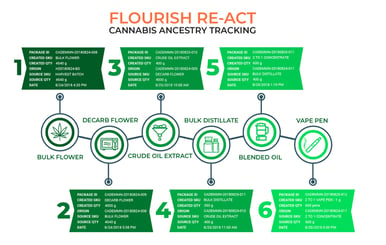
Cured inventory moves into lot products and manufacturing runs, and batch-level traceability tracks the flow from input packages to finished goods.
Lab results synced from BioTrack appear on each package as PASSED, FAILED, or PENDING, and split packages inherit their source's result. That is the chain you need when you have to trace a finished unit back to its harvest.
Transport and manifests
Outbound orders become shipments, and clicking "Create Manifest" registers the manifest with BioTrack. Drivers and vehicles are synced to the state system, and only synced drivers and vehicles can be selected. Shipments require two drivers, a future departure time, and a planned route, which matches Florida's transport requirements. We also document the state system's limits, such as the 1,000-package cap per manifest and the single-stop-per-destination rule, so your team isn't blocked when trying to manifest.
Retail and patient dispensing
Flourish's Florida POS validates patients and dispenses sales to the Medical Marijuana Use Registry through the state integration at the time of sale, including caregiver handling for minor patients.
Because the POS runs on the same inventory record as your grow and your lab, the unit on the shelf is the same record as the harvest it came from.
Choosing a platform
New licensees have choices. Dutchie is a popular choice for point-of-sale. It also markets a cultivation and manufacturing product with plant tracking, batch management, bills of materials, and wholesale distribution, but it's not generally used outside of retail.
Canix supports Florida BioTrack integrations. Cresco Labs notes that its Florida operator Bluma "uses Canix for cultivation and production operations and Dutchie for its retail operations," both integrated with BioTrack.
BioTrack also sells its own commercial software alongside the state system it operates.
Our recommendation is not "avoid any of these." It is to test each vendor against Florida's specific model:
- Where did the product start? Retail-first and upstream-first platforms make different trade-offs. Ask to see a full Florida harvest, including wet weights, dry weights, and cure, followed by a manufacturing run and a manifest, performed live in the state integration and not on slides.
- Who has done this in Florida? Ask for Florida operators you can call, and ask how long their state integration took.
- What will it cost at 5 stores and at 40? Flourish publishes its pricing to support a limited budget in the start-up space and to grow with your business. Ask every vendor for a written price at your year-three footprint.
Frequently asked questions
When must a new Florida MMTC request cultivation authorization?
A new MMTC must request cultivation authorization within 180 days of licensure, processing authorization within 270 days, and dispensing authorization within 365 days.
These are deadlines to request authorization. Approval depends on the Department's review, which in our experience often takes longer than operators plan for.
Does my seed-to-sale system have to be integrated with BioTrack before I can cultivate?
Under the integration rule, an MMTC licensed after the rule took effect must attend three training sessions and submit a written integration plan so that it achieves full real-time API integration with the state system before obtaining cultivation authorization.
Confirm current requirements with the Office of Medical Marijuana Use, because the emergency rules were replaced by permanent rules effective August 24, 2026.
Can I use BioTrack directly instead of a third-party system?
Florida licensees don't log in to the state BioTrack system directly. Operators interact with it through an approved internal seed-to-sale system connected by API. You do not need to purchase BioTrack's commercial software.
BioTrack also sells commercial software, which is a separate product from the state system it operates.
What happens if my system loses its connection to the state?
If your system is disconnected from the state system for more than two hours, you must notify the Department by email at ommu_seedtosale@flhealth.gov within three hours of when the disconnection began.
Your integration plan must also describe how you will track marijuana during the outage and send that data to the state once the connection is restored.
Can my seed-to-sale system also be my point of sale?
Yes. Florida's rules state that an MMTC's internal seed-to-sale tracking system may also serve as its point-of-sale system.
For a vertically integrated operator, keeping cultivation, manufacturing, and retail on a single record reduces the reconciliation work that the state's location and adjustment rules would otherwise require.
What if I choose a vendor now and want to switch later?
You can switch, but you must submit a new written integration plan through the state's variance process before instituting the change. If you selected a choice during the initial licensing, now's the time to pick an alternative.
A long-term decision deserves a long-term partner
You have spent years and significant capital reaching this point, and the technology you choose now will sit underneath every plant, batch, manifest, and patient transaction for the life of your license. We have operated in Florida since 2017 and on the state's BioTrack integration since it launched. We would welcome a conversation about your technology roadmap as you stand up your MMTC. You can learn more about how Flourish supports Florida operators on our Florida state page.